Penghu Living Museum
Bringing Local Culture to Life Through Tangible Interactions
/ 01 Overview
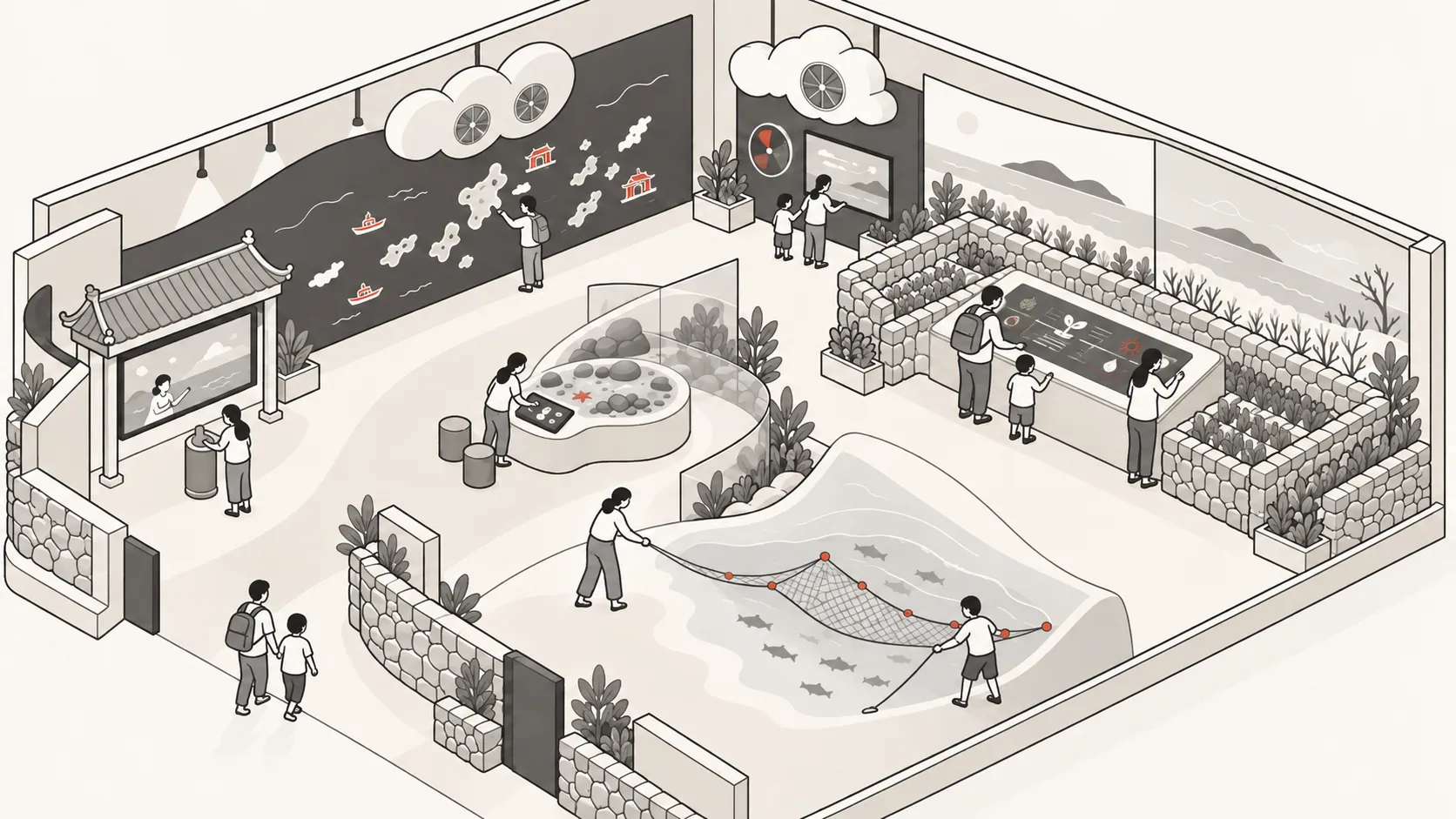
I contributed to the development of an interactive exhibition at Penghu Living Museum, designed to introduce visitors, particularly children, to Penghu's local traditions and cultural heritage. Through hands-on experiences, the exhibition brought traditional farming, fishing practices, local folklore, and island geography to life.
As a Unity Programmer, I developed interactive software for seven exhibits, working with a multidisciplinary team to translate the intended visitor experiences into functional interactions.
I collaborated with mechanical engineers to define how physical inputs would be communicated to Unity, discussed implementation approaches and interaction refinements with the project manager, and worked with 2D and 3D artists to integrate visual content and animations.
Details
| Organization | Corma New Media |
|---|---|
| Role | Unity Programmer |
| Timeline | 2021 |
| Platform | Unity |
| Focus | Interactive Installations · Physical-Digital Integration · Interaction Development |
Exhibition walkthrough
Penghu Living Museum — Interactive Cultural Exhibits (2021)
Building Interactive Experiences
The exhibition combined physical mechanisms, sensors, touchscreens, and projected digital content to create different forms of hands-on interaction. The following are three examples of the experiences I helped bring to life.
Seasonal Farmingdemo
Inspired by Penghu's traditional farming practices, this exhibit invited visitors to explore how crop suitability changes between summer and winter.
Up to four visitors could select and plant crops across two multi-touch displays. Crops grew or withered depending on the current season, while a surrounding projection depicted the corresponding seasonal environment.
Collaborative Fishingdemo
This exhibit introduced Penghu's traditional communal fishing practice, in which local residents work together to pull fishing nets toward the shore.
Visitors pulled two physical ropes to advance a shared fishing animation. I refined the input-to-animation mapping to keep individual pulling responsive while preventing the sequence from progressing too quickly when both sides were active.
Interactive Island Mapdemo
Penghu is an archipelago made up of numerous islands, each with its own name and history. This exhibit invited visitors to discover the stories behind these island names through an interactive map.
Physical touch sensors embedded in the wall triggered corresponding island animations and audio. To align the projected colored graphics with the printed outlines on the wall, I developed a manual calibration tool that allowed individual visual elements to be repositioned, scaled, and rotated.
Other Interactive Experiences
Other installations included a fan-controlled monsoon experience, RFID-based fish discovery, and fortune-stick storytelling with coordinated audiovisual and hardware feedback.
Featured Design Decision
Preserving Interaction Continuity During Seasonal Changes
The Challenge
The Seasonal Farming exhibit was connected to a larger environment that periodically switched between summer and winter. However, visitors could still be planting crops when a seasonal transition was scheduled.
An immediate transition could interrupt an ongoing activity. Meanwhile, the two farming displays operated on separate PCs, introducing additional coordination requirements.
Design Decision & Implementation
I identified these potential conflicts and discussed them with the project manager. Rather than immediately switching seasons, I proposed a transition mechanism that accounted for each player's current activity.
When a seasonal change was requested, inactive player stations entered a waiting state while active visitors were allowed to complete their sessions. New sessions were temporarily prevented from starting.
I implemented player-state tracking and Socket.IO communication to coordinate readiness across the two farming applications and the seasonal projection system. The transition proceeded only after all four player positions had reported ready.
Outcome
The resulting system coordinated seasonal changes across the exhibition without forcing visitors to abandon an ongoing planting activity. It maintained a shared seasonal context while allowing individual sessions to finish.
Coordinating Seasonal Changes
01 / Request
Season change requested
Scheduled transition
02 / Check player states
Idle players
Player 1 · Player 4
Idle → Locked
Ready now
Active players
Player 2 · Player 3
- Playing · Not readyWait for the current session to finish.
- Idle → LockedReady
These are parallel paths. Player groupings are illustrative.
03 / Ready gate
All four players must be ready
Required: 4 / 4
Wait until every player position has reported ready.
04 / Switch together
Summer ↔ Winter
- Farming displaysBoth farming applications
- Environmental projectionThe shared seasonal environment
Reflection
This project strengthened my ability to translate physical interactions into functional digital experiences. Beyond integrating hardware and software, I learned to consider how system behavior, feedback, and timing affect the way visitors interact with an installation.
Many interaction decisions were refined through implementation and iterative adjustments. Looking back, I recognize the value of complementing this practical approach with systematic usability evaluation, particularly when comparing alternative interaction behaviors and assessing whether they communicate the intended experience.